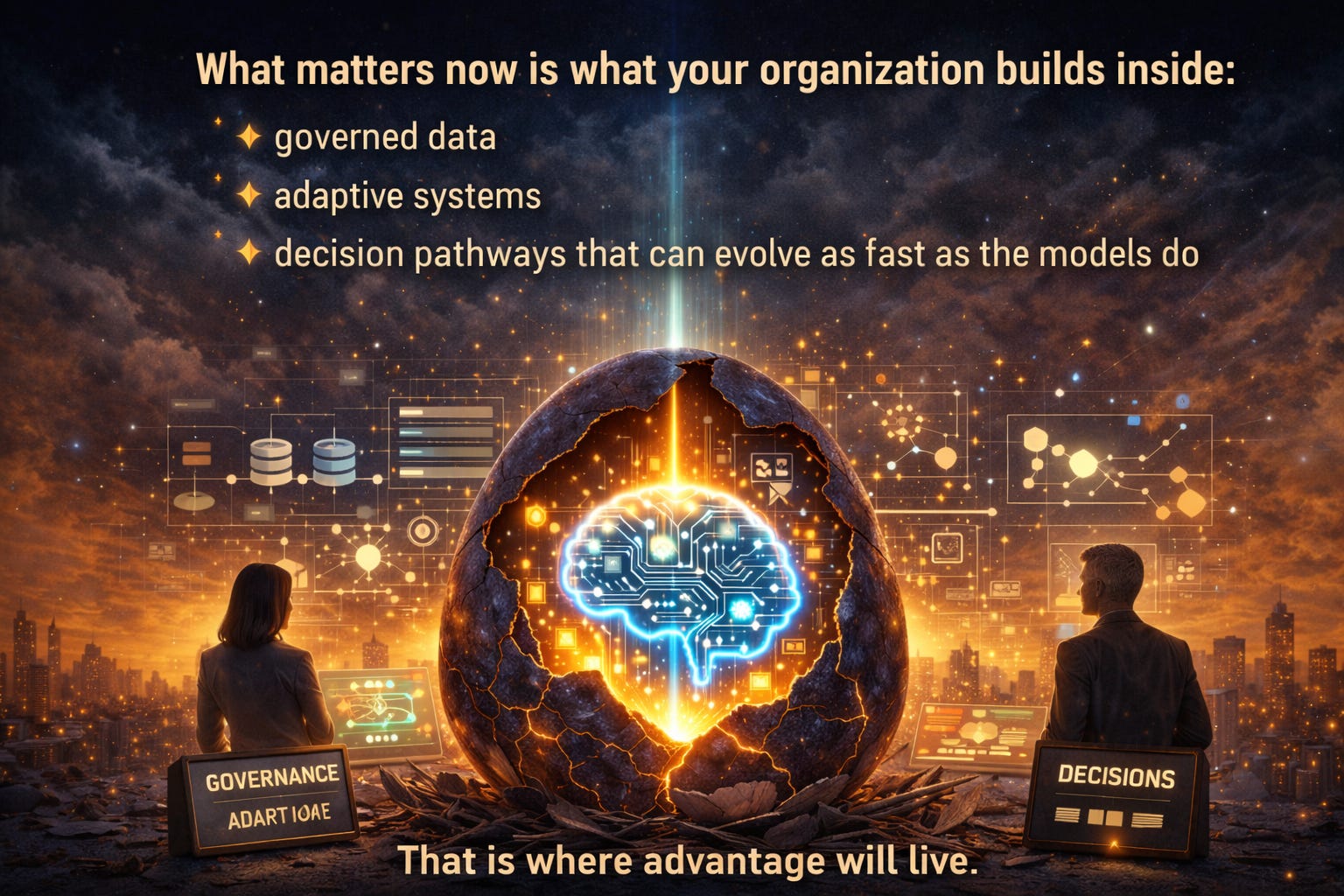
Caring for the Hatchlings

Frequent model releases aren’t chaos.
They’re a signal.
Something fundamental is happening beneath the surface of AI, and most organizations are still reacting to the noise instead of recognizing the pattern.
We are watching intelligence move from scarcity to abundance.
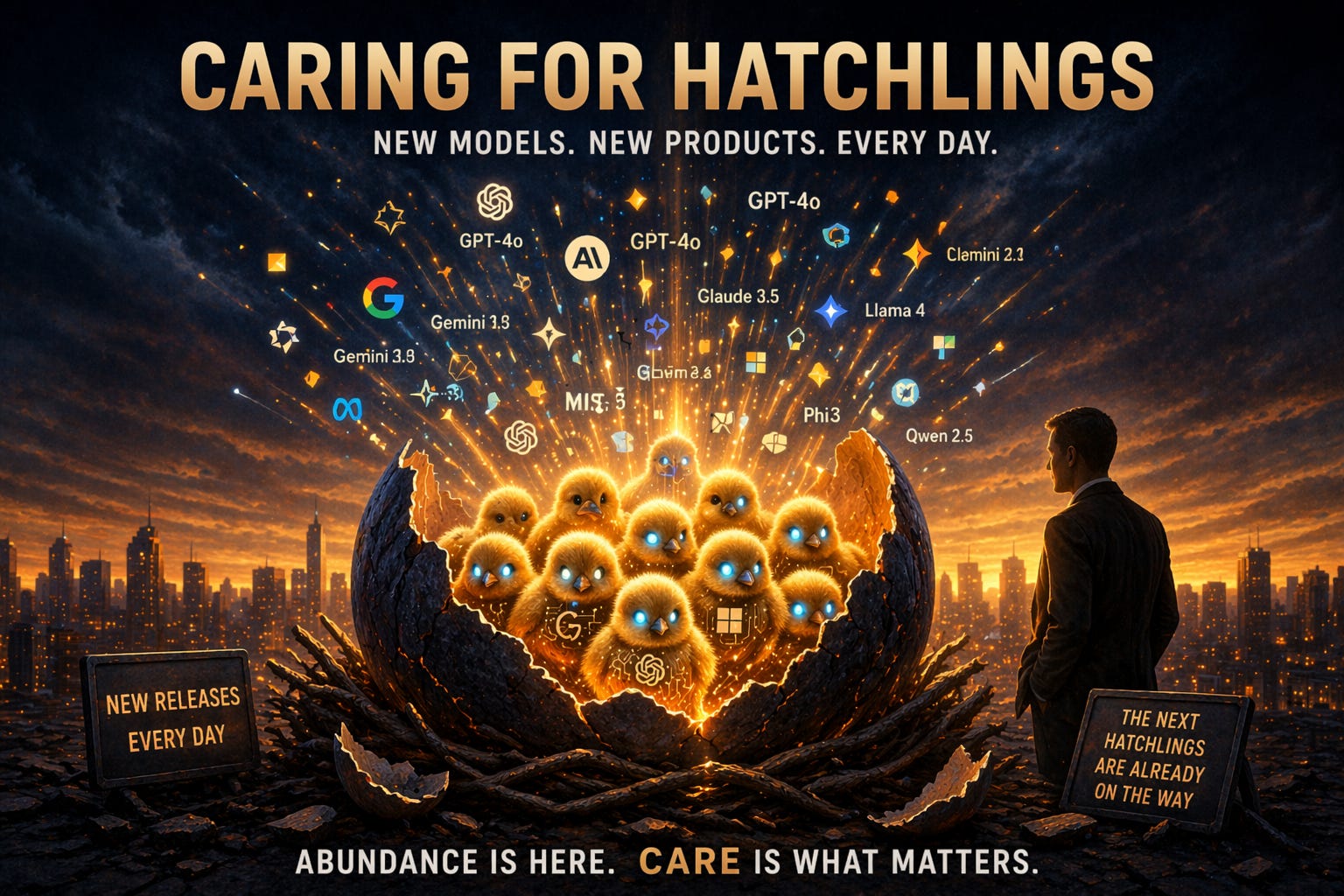
Not long ago, models were rare.
Access was controlled.
Progress came in visible, punctuated leaps.
A new model release was an event. A milestone. A differentiator.
Today, that world is gone.
Models are everywhere.
Performance is converging.
Releases arrive in a steady, accelerating stream.
The egg has cracked.
And what’s emerging is not a single, dominant form of intelligence. It is a dynamic, fast-moving living ecosystem, and impossible to control through the methods we used before.
This is where many organizations misread the moment. They are still evaluating models as if they are finished products.
They are not. They are hatchlings.
Hatchlings are not stable.
They are not fully formed.
They are not self-sufficient.
They require care, structure, and guidance to survive — and more importantly, to become something useful and safe in the world.
Left alone, they are unpredictable.
Handled poorly, they can cause harm.
Scaled without discipline, they create chaos.
But nurtured correctly, they evolve.
This is the shift.
The competitive question is no longer:
Who has the best model?
It is:
Who can raise them?
The landscape is reorganizing in real time:
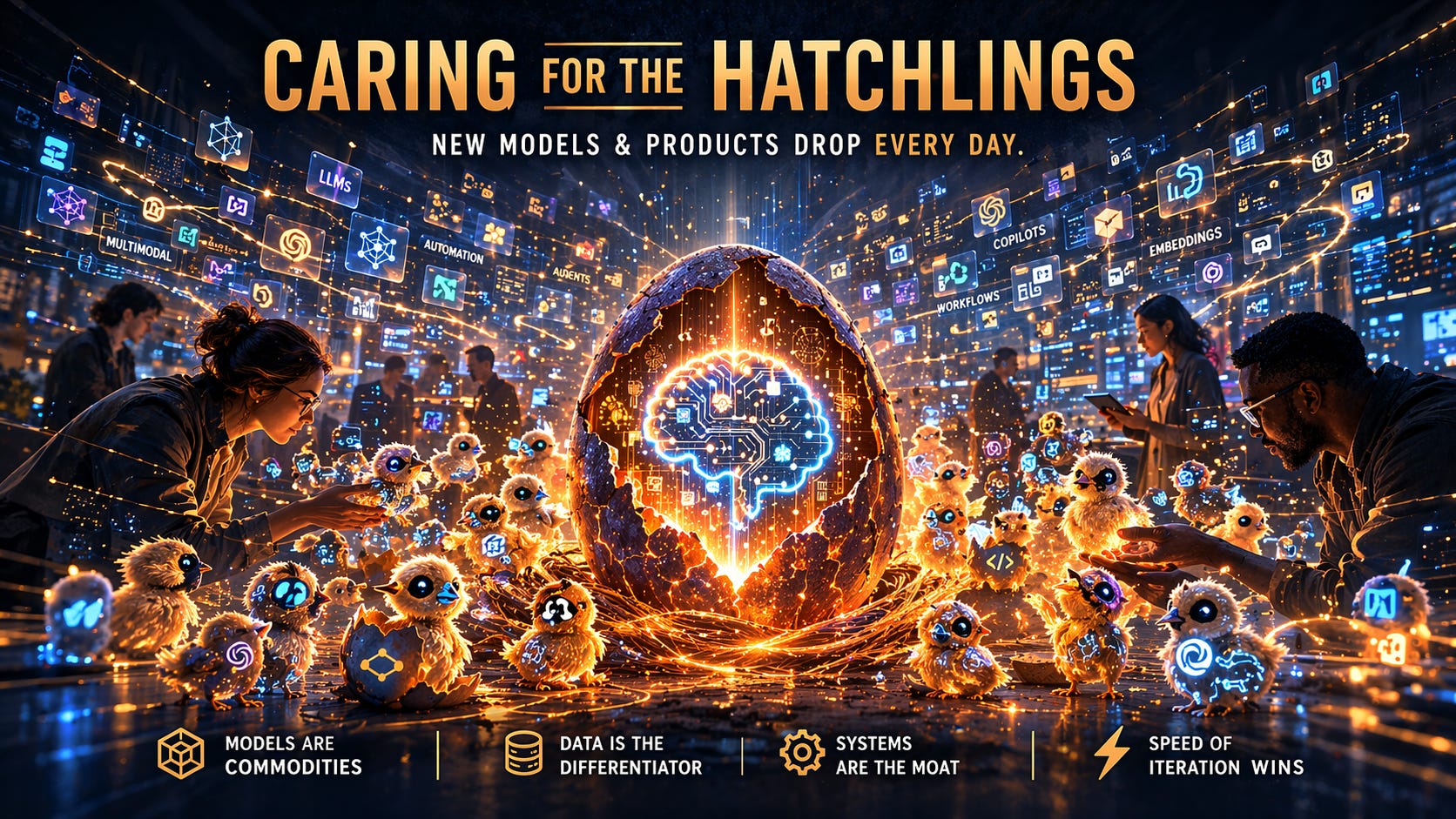
🧠 Models are becoming commodities
🧬 Data is becoming the differentiator
🏗️ Systems are becoming the moat
And underneath all of it, a more important truth is taking hold:
⚡ Speed of iteration is surpassing peak performance
Because when everything is improving at once, advantage does not come from owning the most powerful model.
It comes from learning faster than everyone else.
It comes from adapting systems, data, and decisions in motion — not after the fact.
From a Cracked Egg perspective, this is the moment where governance either evolves or collapses.
Traditional governance was built for a world where decisions were slow and human-mediated.
Where systems executed exactly what they were told.
Where control could be asserted through documentation, review cycles, and approval gates.
That world cannot manage hatchlings.
You cannot govern something that is learning, adapting, and acting in real time with static documents and delayed oversight.
The shell has already broken.
Now the question is whether your organization is prepared to operate inside what comes next.
Caring for hatchlings requires a different kind of system.
Not policies that sit on a shelf, but constraints that live inside execution.
Not oversight after decisions are made, but authority embedded at the moment of action.
Not roles defined by hierarchy, but roles defined by function: Guardians, Makers, and Seekers operating together in real time.
It requires environments where:
✨ Data is governed, connected, and meaningful
✨ Systems can enforce what is allowed and prevent what is not
✨ Decision pathways are designed, not assumed
✨ Learning cycles are continuous and visible
Because hatchlings do not wait for approval.
They act.
And if your systems cannot guide that action, your governance does not exist where it matters.
This is why the future will not be won by the organizations with the best models.
It will be won by the organizations with the best environments for raising them.
The ones that can:
🐣 Introduce new models safely and quickly
🐣 Constrain behavior without slowing innovation
🐣 Learn from outcomes and adapt immediately
🐣 Align people, systems, and data into a single operating flow
Because in a world of abundance, the rarest capability is not intelligence. It is the ability to shape it.
The punchline is simple.
“We are no longer building models. We are caring for AI hatchlings.”
And that requires something most organizations do not yet have:
Great systems. And great people - aligned, empowered, and operating at the speed of the environment they are responsible for shaping.
The egg has cracked.
What emerges next will depend entirely on how well we raise what comes out of it.